
Aruzhan Kassenova’s Journey in Rhythmic Gymnastics
- Selah - The Rhythmic Report

- May 19
- 7 min read
Aruzhan Kassenova, 19, was born and raised in Astana, Kazakhstan. She first started rhythmic gymnastics at three and a half, when her mother enrolled her in a club. At the time, it was nothing serious, just a sport to keep her active. However, that all changed after Aruzhan turned 10. It was her first National Kazakhstan Championships in the pre-junior category, and she placed eighth, which was the very last qualifying spot for the national team - and from then on, Aruzhan had to prove she deserved her place on the national team. After making the national team, practice got more serious, and Aruzhan started training alongside senior gymnasts competing at the highest levels.
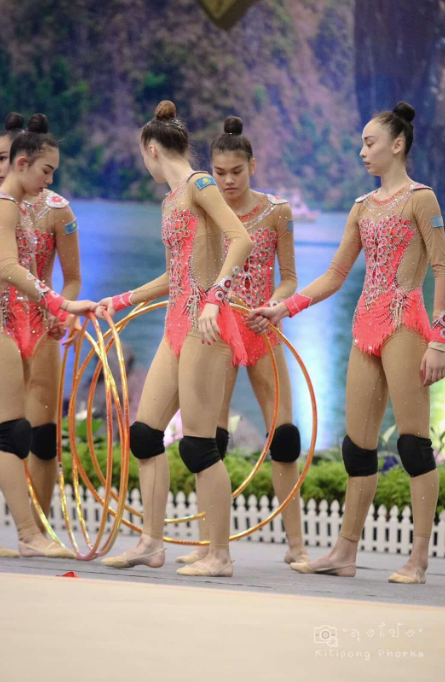
Aruzhan started as an individual gymnast and competed as one from the moment she made the national team until her first senior season. The change from individual to group happened after her last competition of the season. Her coach sat her down for an honest conversation, telling her, “You can either wait for an individual spot as an international competitor, or you can join a group and try for major competitions: World Championships, Asian Championships, World Cups.”
However, the biggest issue was that Aruzhan was left-handed, and in group gymnastics, synchronisation is everything. So she started training from her right side from scratch to have a chance of making it into a group.
Even after that, she was not chosen for the
group at the initial selection. She went to St. Petersburg as a second reserve and gave everything. Her coach saw her effort, and Aruzhan secured a place in the main national group team.

Her first competition was the 2022 World Cup in Athens, where she placed fourth in the all-around and won bronze with five hoops. One month later in Tashkent, Aruzhan’s group won silver in the all-around, silver with three ribbons and two balls, and bronze with five hoops. At the 2022 Asian Championships in Pattaya, she won gold with five hoops and bronze in the group all-around.

In 2023, at the Asian Championships, Aruzhan became captain of the group. It was not planned - on the first day of competition, their team made a serious mistake, and the coach gathered everyone and said that they needed a new captain. Everyone unanimously voted for Aruzhan.
Then, after seven years on the national team, many medals, life lessons, and years of experience, Aruzhan retired. She kindly agreed to answer some questions about her journey in rhythmic gymnastics.
What first made you fall in love with rhythmic gymnastics?
“It wasn’t one single thing. The concept of rhythmic gymnastics is so unique that the moment the music starts, your body just responds to it. I th
ink that connection was already in me. I remember being two years old, and my mom would put music on, and I would just start moving. I didn’t know what dance was. I just felt the music, and my body followed.
And then there is the apparatus, the ribbons, the balls, the hoops. Watching the older girls doing these huge tosses and catches captivated me completely. The music, the movement, the skill, the beauty, that combination is what made me fall in love with it.”
What do you like about group gymnastics, and how do you feel it’s different from individual?

“The best way I can describe it is shared energy. In individual gymnastics, you face everything alone; every mistake is yours to carry. In a group, a mistake belongs to all five of you. So does every victory. We lived together, trained together, and became like a family. When the pressure came, you didn’t have to face it alone.
I genuinely think group gymnasts come out of the sport with less psychological damage than individuals because you’re never truly alone in it. The one thing individual gives you that the group doesn’t is complete ownership. Every result is purely yours. There’s freedom in that, too. But for me, what group gave me was worth more.”
Why do you think group gymnastics is less popular than individual gymnastics?

“In individual gymnastics, you watch one person, learn her name, follow her season. You can recognise the elements and feel connected to her story.
In a group, you’re watching five people at once, trying to follow synchronisation and exchanges, and athletes change, so you rarely get attached to specific names. People follow athletes, not just teams. When you can’t put a face to what you’re watching, it’s harder to care.”
Why do you think you were voted to be the group captain?

“I think it was because of the relationship I had with the team. I remember one night taking a teammate to the gym after training and going through every step of the routine together, where to stand, how to throw, how to make it feel natural, and my coach noticed.
Becoming a captain also added more
responsibility.
I had to be the bridge between the coach and the team. That’s where my coaching really began. It gave me my first real understanding of what it means to guide people, and that experience laid the foundation for everything I’m doing now.”
Who was the most important person in your career, and how did they support you?
“There isn’t one person. But if I have to speak about the most influential, I’d start with my parents. They were always on my side, unconditionally. They were my safe place, somewhere I could say anything and know I’d receive love and support, not judgment.
And then there’s my coach, the coach brought in to lead our group program. From the moment she walked into the gym, something changed. At first, there was a bit of fear, but by my second year with her, that changed. She taught me so much beyond gymnastics; she changed the way I looked at the sport and the whole system. She didn’t just influence how I competed, but my mindset and how I think.”
When you started training seriously, what did an average day look like for you?

“We all lived together at the training base in Shymkent, so there was no separation between training life and regular life.
Morning exercise at 9 a.m., breakfast at 9:30, then the first session from 10 a.m. until 2 or 3 p.m. A break for lunch and rest, then the second session from 3 or 4 p.m. until 8 p.m., working through both competition programs. Back to the room, asleep by 11. Same thing the next morning. Six days a week, one day off.”
How did you physically feel over the years? Did you deal with any serious injuries?
“I was relatively lucky. Towards the end of 2023, my foot was giving me trouble. With that training load, it’s hard to stay completely healthy, but I never had anything truly serious throughout my career.
What helped me was being open about it. The moment something didn’t feel right, I’d tell my coach. Ignoring pain is how small problems become career-ending ones. My coach understood that and would let me modify certain elements when needed.”
What developments would you like to see in Kazakhstan when it comes to rhythmic gymnastics?
“I’d love to see Kazakhstan become a consistent leader on the world stage, and I genuinely believe we’re heading there. There’s a strong new generation coming through. I’d also love to see more space given to younger coaches with modern methodologies. The sport is evolving globally, and Kazakhstan should evolve with it.”
What was your proudest moment of your career representing Kazakhstan, and what did it mean to you to represent your country?

“The entire 2022 and 2023 seasons. We won World Cup medals seven times and became Asian Champions. I’m proud because I feel like our team helped open a door. We proved something, and we raised Kazakhstan’s ranking. We built
something the next generation can build on. That means more to me than any medal.”
“It was an enormous responsibility, and an honour that’s hard to put into words. You’re not just competing for yourself anymore.
The moment that captures it best is when the flag rises to the top of the podium, and the anthem plays. In that moment, everything, every sacrifice, every early morning, every hour of training, every tear, makes sense.”
What led to your retirement?
“This is still not easy to talk about. My retirement came somewhat unexpectedly; I think I could have continued. But circumstances outside of my control made it impossible to go on. There are realities in elite sport that exist beyond talent, hard work, and results, and sometimes those realities decide things for you.
What I can say is that I’m at peace with how it ended. I stayed true to my values throughout my career and left the sport with my integrity. That matters most.”
How has your life changed since retiring, and what do you see in your future?

“My life changed completely; a second life began. When you spend thirteen years growing up inside the world of gymnastics, you don’t really believe another world exists. Then suddenly it’s gone. At first, it was painful. I disconnected from teammates and threw myself into new things just to stay busy, such as popping dance, foreign languages,
and exam preparation.
But it felt strange; during my career, everything had been decided for us. Suddenly, I had to do all of it myself. I took a gap year. I started coaching children, worked on self-education, prepared for exams, kept dancing, and even won some competitions in popping.”
Are you still involved in the sport in any way, or do you have new goals you’re working towards?
“Yes, I’m coaching children, though not at a professional level. My goal is simple: to make kids fall in love with the sport, just to give them something beautiful to connect with.
Long term, I see myself as a coach, specifically in group gymnastics. I believe I have something to pass on, an understanding of how a group works and how to build connections between people. But right now my focus is on my education.”
Was retirement hard mentally? What advice would you give gymnasts who are struggling after retirement?

“Yes, especially finding a new passion and going through that period of emptiness. No one can go through it for you. My parents were a huge support, but it still took time.
At first, I felt fine, like I was just on a break. Then slowly the realisation settles in: this is your life now, and you’re the one who decides what to do with it.
My advice: start preparing at least a year before you retire. Explore what else interests you while you’re still competing. Try new things, invest in your education, and if possible, have something you love outside of sport.”


